

The Collision Pattern - Why Your Archetype and Birth Numbers Create Your Biggest Challenge
An archetype challenge pattern is the recurring stuck point that appears when your dominant Jungian archetype (the survival strategy you learned) conflicts with the Challenge Line in your Matrix of Destiny (the energy signature calculated from your birth date). When the two forces pull in opposite directions, you get a loop that willpower cannot break, because the loop is structural, not moral.
That is why the same problem keeps returning in different costumes: the unopened banking app, the project you research instead of start, the relationship you leave the moment it gets close. You have probably tried therapy tools, journaling, and personality tests. They describe the behavior. This framework maps the collision underneath it, so you can work with the pattern instead of blaming yourself for it.
01The Two Forces Behind the Pattern
Force 1: Your archetype - the strategy you learned
You were not born with an archetype. You built one. In Jungian terms, an archetype here is a behavioral operating system: a bundle of core desire, core fear, strength, and shadow that you assembled to stay safe and belong. (New to the concept? Start with what archetypes are.)
Two quick profiles show how specific this gets:
- The Caregiver. Core desire: protect and nurture. Core fear: being selfish or abandoning someone. Strength: sensing needs before they are spoken. Shadow: self-abandonment - your worth depends on being needed, so you create dependence, resent it, feel guilty, and help harder to atone.
- The Warrior. Core desire: prove worth through mastery. Core fear: weakness or cowardice. Strength: courage under pressure. Shadow: ruthlessness - rest reads as failure, asking for help reads as defeat, and when external challenges run out, you invent internal ones.
Notice that neither is a trait list. Each is a loop. This is one reason Jungian archetypes and self-sabotage are so tightly linked: the sabotage is usually the shadow side of a strategy that once worked.
Force 2: Your Matrix Challenge Line - the energy you were born with
The Matrix of Destiny calculates eight positions from your birth date, each mapped to one of the 22 Major Arcana (used as energy signatures for reflection, not fortune-telling). The positions cover core energy, karmic inheritance, talents, relationships, resources, purpose, spiritual mission, and one position that matters most here: the Challenge Line, the place where your energy most often tips from its plus state (flow) into its minus state (imbalance).
Two examples:
- Position 15 (The Devil) as Challenge Line. Plus state: healthy boundaries, material stability, pleasure without guilt. Minus state: attachment - staying in bad situations because leaving feels like losing, hoarding money, refusing to delegate.
- Position 18 (The Moon) as Challenge Line. Plus state: trusted intuition, comfort with ambiguity. Minus state: fear of the invisible - decision paralysis, overthinking, avoiding change because the unknown feels dangerous.
Keep reading: Your Matrix of Destiny Challenge Line (the friction position in depth) and The 12 Archetypes & Collision Patterns (field guide to each survival move).
Ready to see your pattern?
Take the free 3-minute quiz to discover your archetype + Matrix collision pattern.
Start Free Analysis →02Why the Two Forces Collide
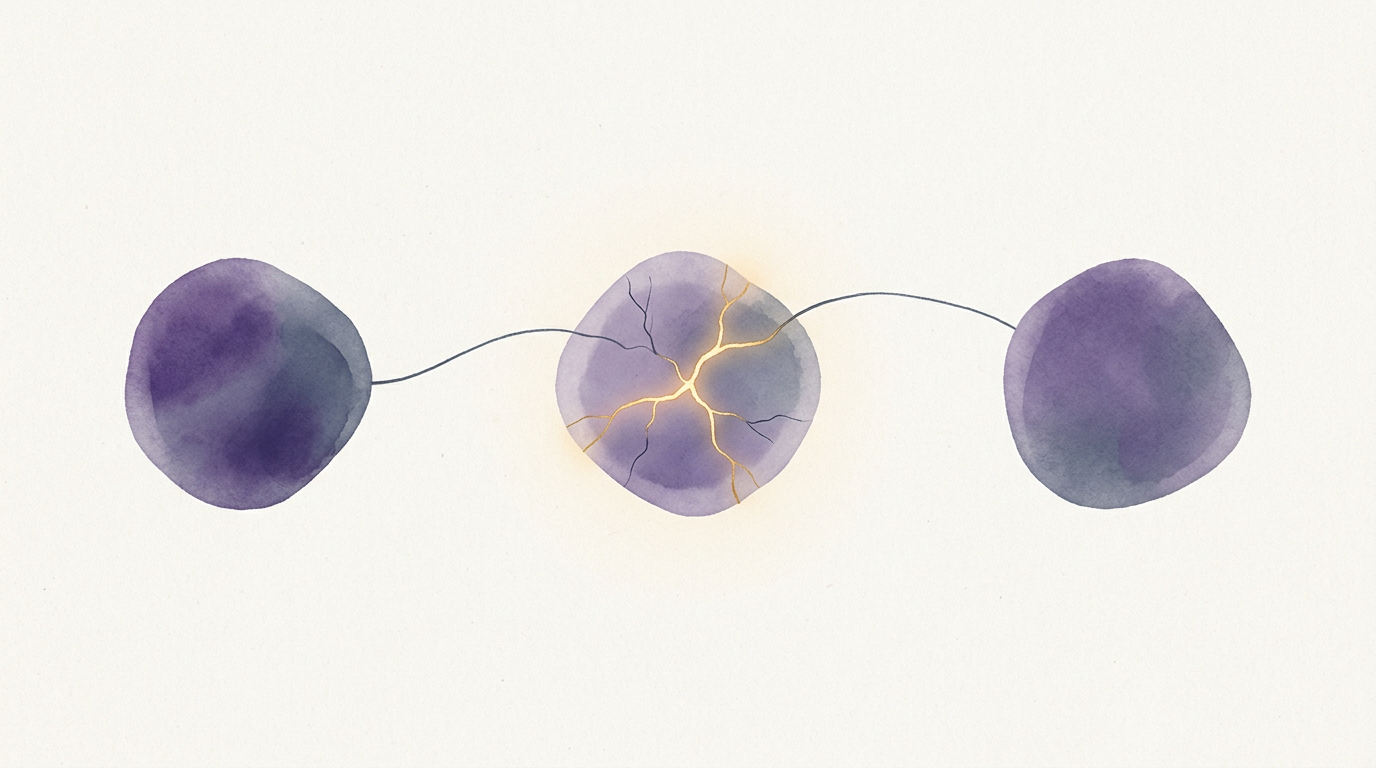
The mechanism is simple to state: the archetype says "do this to be safe," and the Challenge Line's minus state says "but that violates your core pattern." The friction between the two instructions is the stuck point. You can often see the pattern clearly and still not break it, because seeing is not the same as resolving a structural conflict.
Here is one collision worked end to end.
Caregiver + Position 8 (Justice), in money. The core collision sentence: "I can't charge what I'm worth, because fairness means being accessible to everyone."
- Archetype tendency: Caregivers feel valuable when they are needed, so helping is non-negotiable.
- Matrix amplifier: Justice energy insists on balance. Charging for help feels unfair to anyone who cannot pay.
- Behavioral loop: undercharge or work free → burn out → resent the people you help → feel guilty for resenting them → help more to atone.
- What you actually notice: always broke, always tired, quietly angry at people you claim to love serving.
"Charge more" fails here, because raising prices directly triggers the Justice alarm. What loosens the loop is a reframe both forces can accept: fairness does not mean equal access, it means sustainable exchange. The Caregiver still helps; Justice is still honored; the collision loses its grip.
Does this sound like you?
12,000+ people have discovered their exact collision pattern. Find yours in 3 minutes.
Take the Free Quiz →03Collision Signatures: A Reference Table
Collisions cluster into six life areas: money, career, relationships, health, purpose, and time. The table below shows common signatures - the collision sentence you would recognize, and the reframe that lets both forces coexist.
| Archetype | Challenge Line | Life area | The collision sentence | The reframe that loosens it |
|---|---|---|---|---|
| Caregiver | 8 - Justice | Money | "Charging my worth is unfair to those who can't pay." | Fairness is sustainable exchange, not equal access. |
| Ruler | 15 - The Devil | Money | "If I lose money, I lose power, so I hoard and never feel safe." | Security comes from boundaries, not grip. |
| Warrior / Hero | 4 - The Emperor | Career | "I can't start until the plan is perfect." | Structure is the container that permits messy action. |
| Sage | 15 - The Devil | Career | "Too smart for this job, too scared to leave." | Superiority is often fear wearing a costume; test it with one small exit step. |
| Seeker | 6 - The Lovers | Relationships | "I want connection but feel trapped when I get it." | Intimacy is chosen presence, not confiscated freedom. |
| Orphan | 6 - The Lovers | Relationships | "Abandonment is coming, so I create distance first." | Let closeness be tested by reality, not pre-empted by prediction. |
| Hero | 18 - The Moon | Health | "Rest is weakness; I push until my body stops me." | Rest is maintenance of the instrument the mission depends on. |
| Sage | 18 - The Moon | Purpose | "I must fully understand before I act." | Acting is how understanding arrives; run small experiments. |
| Magician | 1 - The Magician | Purpose / Time | "Infinite ideas, nothing finished." | One container per season; possibility needs a fence to become work. |
Read the table as a set of reflection prompts, not verdicts. If a row makes you flinch with recognition, that flinch is data.
Want to see how precise it gets?
Most people say "how did it know that?" Take the quiz and see.
Start Free Analysis →04Why Other Tools Describe It but Rarely Name It
If you have asked "why am I stuck in life?" in a therapist's office or a personality test, you were not wasting your time. Each tool solves a different problem, and none of them is built to name a collision.
- Therapy frameworks (CBT, DBT, ACT) hand you excellent tools: challenge the thought, regulate the emotion, act on the value. But if a thought like "I'm not good enough" is structurally generated by a Caregiver-Justice collision, you can dispute it a thousand times and it will return, because the collision keeps producing it. Tools work far better once the engine has a name.
- Personality tests (MBTI, Enneagram) describe traits and motivations. The Enneagram can tell you that a Type 2 fears being unloved; it does not explain why that fear becomes undercharging in money but people-pleasing in relationships. Description is not mechanics.
- Traditional numerology gives you numbers with meanings. "Life Path 7: introspective and analytical" is true of millions of people. The Matrix of Destiny adds structure - eight interacting positions with plus and minus states - and pairing it with an archetype makes the reading specific to how you get stuck.
The collision model does not replace any of these. It supplies the missing layer: archetype (behavioral strategy) + Challenge Line (energy pattern) + life area = one nameable pattern you can watch for in real time. Because most collisions live in the shadow side of the archetype, this pairs naturally with shadow work.
Which challenge category is yours?
Choose your biggest challenge in the quiz and get your personalized collision diagnosis.
Find Your Collision Pattern →05How the Free Report Maps Your Pattern
The Elunara quiz builds the collision map in four steps: you choose your biggest current challenge (money, career, relationships, health, purpose, or time), answer 18 behavioral-scenario questions that score all 12 archetypes, and enter your birth date, from which the eight Matrix positions are calculated. The report then combines your dominant archetype (and a secondary one, if two scores sit close together), your Challenge Line, and your chosen life area into a personalized reading.
What you receive is not a label but a working map: your archetype portrait with its shadow layer, your Challenge Line in plus and minus states, the collision equation written out in plain language, the three-step loop it runs, five micro-behaviors to watch for, and a small two-minute experiment to try the same evening. Treat every line of it as a hypothesis to test against your own days, not a verdict about who you are.
See your exact collision pattern in 3 minutes
Free report. No credit card. Instant results.
Start Free Analysis →06From Naming to Rewiring
Naming the collision is the diagnostic step. Loosening it is a practice, and the 90-day protocol structures that practice in three phases:
- Days 1-30, Awareness. Track the collision as it runs: what triggered it today, what it cost, which coping move you reached for.
- Days 31-60, Interruption. Practice small, collision-specific interventions - for a Caregiver-Justice pattern, that might be declining one uncompensated request and sitting with the discomfort instead of fixing it.
- Days 61-90, Integration. Build the reframe into default behavior and course-correct through evening reflection.
The daily tasks adapt to your journal entries, and the therapeutic lens is matched to the collision type: acceptance-based tools for avoidance patterns, emotion-regulation tools for dysregulation, Stoic practices for rigid thinking, body-based practices for somatic disconnection. The point is never motivation. A Hero with an Emperor Challenge Line does not need "just start" - they need four weeks of tracking delay, surviving one imperfect start, and noticing that imperfection did not destroy them.
See your pattern now. Rewire it over 90 days.
The free report reveals the collision. The full protocol rewires it. Start with the free quiz.
Take the Free Quiz Now →07The Pattern Is Structural, Not Moral
Psychological patterns repeating across years are rarely evidence of weak character. More often they are evidence of two coherent systems - a learned survival strategy and an inborn energy signature - issuing contradictory instructions. Shame cannot resolve that contradiction; naming it can.
Your archetype is the strategy you built. Your Matrix Challenge Line is the energy you were born with. Where they collide, you get your biggest challenge - and also your clearest starting point, because a named collision can be observed, interrupted, and gradually reframed.
Discover Your Collision Pattern
18 questions. 3 minutes. Instant personalized report showing your archetype + Matrix collision.
Start Free Analysis →No credit card required. 100% private.
✦ Frequently Asked Questions
What is an archetype collision pattern?+
An archetype collision pattern is the behavioral loop created when your Jungian archetype (who you became through experience) conflicts with your Matrix of Destiny number (the energy you were born with). This collision creates recurring stuck points in specific life areas like money, career, or relationships.
How do I find my archetype collision pattern?+
Take the free Elunara quiz - it scores your archetype through 18 behavioral questions and calculates your Matrix numbers from your birth date. Our AI then generates a personalized report showing your exact collision pattern and a 2-minute experiment to disrupt it.
Can I have more than one archetype?+
Yes. If your top two archetype scores are within 10% of each other, you have a dual-archetype pattern. This creates an internal war where both archetypes fight for control, which amplifies the collision effect and makes progress harder.
Is the Matrix of Destiny the same as regular numerology?+
No. Regular numerology gives you isolated numbers and generic interpretations. The Matrix of Destiny maps 8 positions that interact with each other and, in Elunara's system, are analyzed alongside your archetype to reveal precise behavioral collision patterns.
Which of the Twelve Is Actually Running You?
Not the one you identify with. The one your answers show, read alongside your Matrix position and the challenge you choose.
16 questions · about 3 minutes · free