
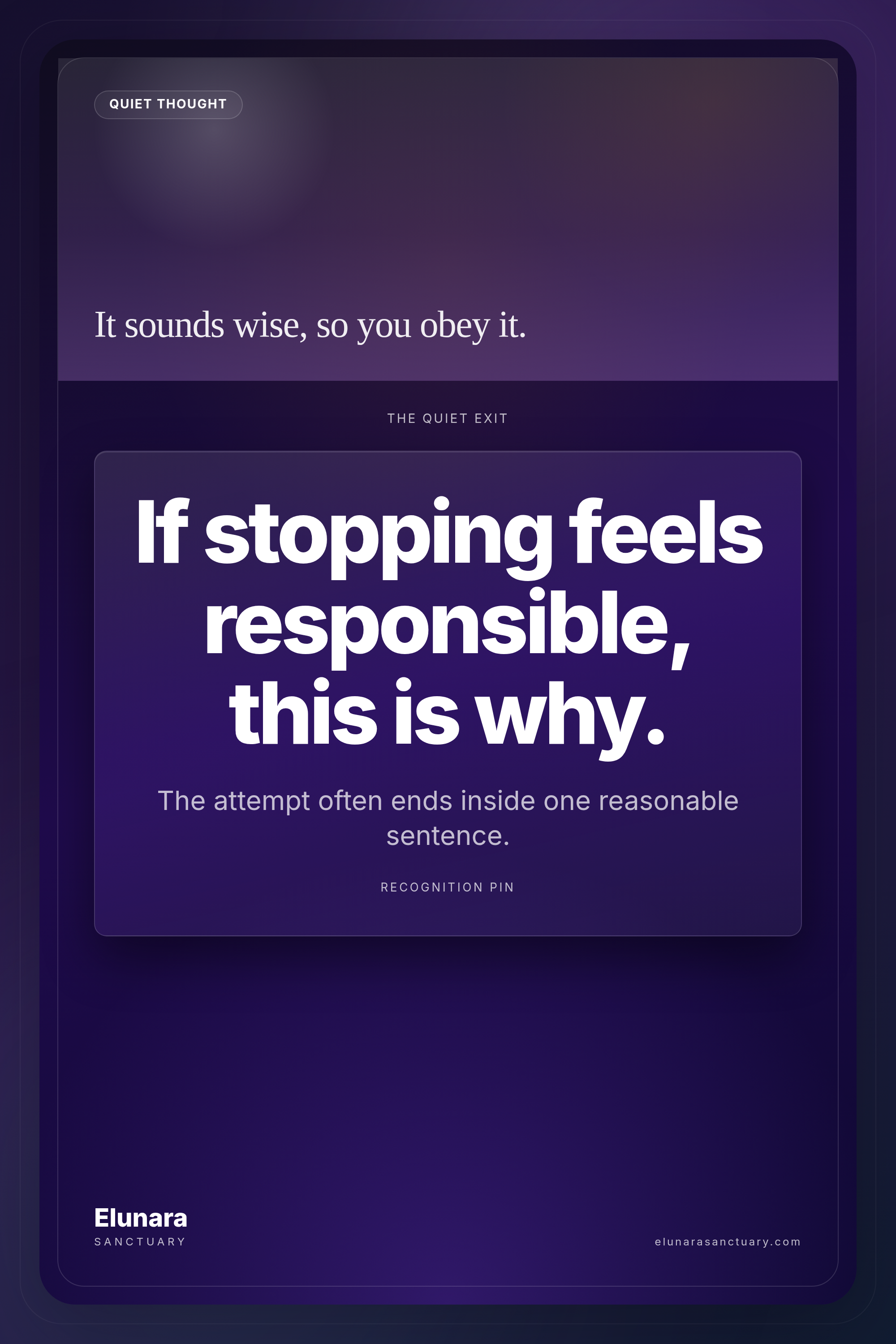
The Quiet Thought That Ends Every Attempt You Make To Change
Progress rarely dies in fireworks. It dies in a sentence so reasonable you barely notice you obeyed it.
That sentence is not loud. It does not announce itself as self-sabotage. It arrives at a specific moment in a specific sequence — and because it sounds rational, because it sounds like wisdom, you follow it. And the thing you were building stops.
01Where The Pattern Actually Ends
Most people locate the end of their change attempts in the wrong place.
They point to the missed session, the abandoned project, the conversation they never had. They point to the action that did not happen. But the action did not happen because of a thought that arrived before it. And that thought had a specific place in a sequence.
The failure point is not the last visible absence. It is a sentence, usually in the middle of the sequence, that sounds like good judgment.
I should wait until I am in a better headspace. This approach probably needs more refinement before I commit. I have been pushing too hard — taking a pause is the responsible thing.
None of these sentences are wrong on their face. That is the mechanism. The loop's exit strategy is indistinguishable from wisdom until you can see the sequence it appears inside.
02The Reasonable Sentence Problem
Why Rational Thoughts Are The Most Dangerous Step In A Loop
There is a well-documented feature of behavioral patterns: the most effective self-sabotage is the kind that recruits your intelligence to justify it.
A thought like I am afraid and want to stop is easy to recognize and override. A thought like I need to research this more thoroughly before moving forward is almost impossible to catch in real time, because it genuinely sounds like good judgment. It uses your values — thoroughness, responsibility, not rushing — to execute an exit.
Your pattern has learned your vocabulary. It has learned which of your values it can invoke to make stopping feel like a deliberate, considered choice rather than a reflex. This is not a character flaw. It is a feature of how behavioral loops operate. The more sophisticated your self-awareness, often the more sophisticated the rationalization your loop generates.
The sentence is always slightly different for different people. Its content varies by archetype pattern — one person's loop says I need to help this other person first, another's says I need to think this through more carefully, another's says this is not the right moment, I'll know when it is. The structure is identical: a reasonable-sounding sentence arrives at a predictable point in the sequence, the action stops, and the loop has successfully preserved itself for another cycle.
03The Eight Steps — With Step Four Written In Internal Dialogue
Here is the generic sequence. The specific wording at step four is determined by your archetype pattern — but the architecture is consistent.
- The genuine intention. Something matters to you. The commitment is real. You are not pretending. Energy gathers around it.
- Action begins. You start. There is momentum. Something in you relaxes — the gap between intention and action has closed.
- Real friction arrives. Not a crisis. The ordinary difficulty of sustained effort — the part where it stops being new and starts requiring something of you.
- The sentence. Your loop generates a specific thought at this exact moment. If I wait until Monday, I will be more ready. Or: I should talk to one more person before deciding. Or: I think I need a different approach entirely. The sentence is tailored to you. It uses your logic. It sounds like clarity arriving — not like a loop tightening.
- The pause becomes a stop. You follow the sentence. The action pauses. The pause does not feel like giving up — it feels like strategic recalibration. That distinction matters to your nervous system.
- The escape hatch. Another demand surfaces, or a legitimate distraction appears. Your attention moves. This too feels justified — because it is not entirely unjustified. It is simply what the loop uses to make the pause permanent.
- The pressure releases. Relief. Real, neurological relief. This is the mechanism that ensures the loop repeats — the exit is rewarded with a reduction in tension. Your nervous system files this sequence as: stopping = relief.
- The reset. Days or weeks later, the intention surfaces again. You return to it with slightly more self-criticism and slightly less momentum. You tell yourself this time you understand the obstacle better. The loop is ready.
04The Collision Point — Why The Thought Arrives On Schedule
The thought at step four does not appear randomly. It appears at a predictable moment because of two intersecting inputs.
The first is your dominant archetype pattern — the behavioral strategy your nervous system defaults to under pressure. Each of twelve archetype patterns has a characteristic version of step four. The thought that sounds like wisdom is a signature — recognizable once named, invisible until it is.
The second input is your Matrix of Destiny. The Matrix of Destiny is an eight-position mathematical system derived from your exact birth date — no star charts, no planetary positions, just the numbers encoded in the day you arrived. If you are familiar with Human Design or Gene Keys, it operates at a similar level of specificity — a structural map of the energies you came in with. It maps eight specific positions: your relationship with resources, your partnership patterns, your core energy, your challenge line, your purpose direction.
When your archetype's characteristic step-four sentence collides with a specific Matrix position — particularly the challenge line in your chosen life area — the thought arrives with a structural reliability that feels almost fated. Not because you are weak. Because two separate systems are pointing in the same direction.
05Why Affirmations Do Not Intercept This
Affirmations operate at the level of conscious belief. The sentence at step four does not arrive as a belief. It arrives as a perception — a reading of the situation that feels accurate in the moment. You do not need to believe anything in order to follow it. You simply act on what appears to be obvious.
This is why positive self-talk, gratitude practice, and motivational content do not resolve repeating loops. They address the mood state. The loop operates at the level of pattern architecture — below the mood, below the belief, at the level of sequence.
A different input is required: sequence awareness. Knowing which step you are on when the loop is running. Having a specific protocol for what happens at step four — not in general, but for your particular step-four sentence.
The free analysis does not replace your existing self-knowledge. It adds the one layer that converts self-knowledge into behavioral change: the named sequence and the named interruption point.
06Your next step
The free analysis takes approximately three minutes. Your report will show you:
- Your archetype — which of twelve behavioral patterns is running your loop, with your match percentage and the specific shadow behavior it produces in your chosen challenge area
- The Fusion — the equation showing exactly why your specific archetype and Matrix combination creates your specific challenge pattern, built from your quiz answers, not a template
- Your 8-step loop — written from your answers, including the step-four thought your pattern uses and your specific escape hatch at step six
- Five diagnosis points — your exact quiz answers reflected back with their hidden psychological meaning, in the format: "You selected [this]. Here is what that actually reveals."
The free report is the diagnosis. The 90-day protocol (one-time purchase) is the exit: daily tasks adaptive to your archetype and Matrix combination, calibrated each day to your actual state based on your journal entries.
No card required · ~3 minutes · Instant delivery · Private
✦ Frequently Asked Questions
How accurate can a short quiz really be?+
The accuracy comes from the intersection of two frameworks: your behavioral pattern (archetype) and your birth-date blueprint (Matrix of Destiny). The quiz extracts the specific inputs needed to identify the collision. Specificity is structural, not statistical.
Is my quiz data private?+
Yes. Your answers are used only to generate your personalized report and are not shared or sold.
Is this therapy?+
No. Elunara is a diagnostic and protocol product, not a clinical service. If you are working with a therapist, the insights here can complement that work. For clinical concerns, please consult a licensed professional.
I am already in therapy. Is this relevant?+
Many users find the structural framing complements therapeutic work by naming the behavioral architecture their therapy is working within. The two are not in conflict.
Knowing About the Shadow Is Not the Same as Naming Yours
Sixteen questions identify the archetype you lead with and the shadow attached to it, then read both against your Matrix position to find where it costs you.
16 questions · about 3 minutes · free