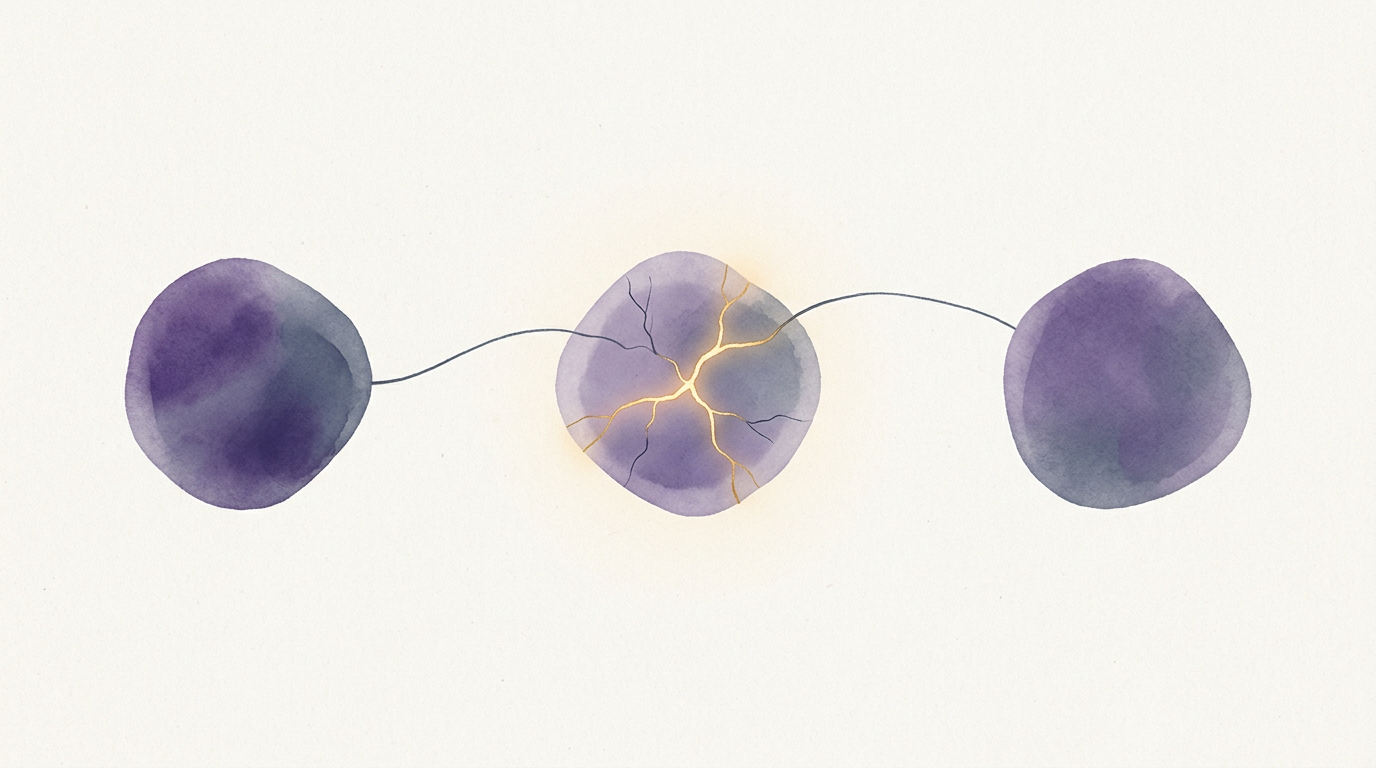
The Collision Pattern — Why Your Archetype and Birth Numbers Create Your Biggest Challenge
You see the banking app notification. Your chest tightens. You swipe it away. Again.
Or: You open your laptop to start the project. Three hours later, you've reorganized your bookmarks and researched fonts. The document is still blank.
Or: The person you're dating says "I love you." You feel a surge of panic. You pull back. They leave. You swear this time will be different. It never is.
These aren't separate problems. They're the same pattern wearing different masks.
You've tried everything — therapy, self-help books, journaling, accountability partners, morning routines, affirmations. Some things work for a while. Nothing sticks. The stuck point returns, wearing a slightly different outfit, but you recognize it immediately.
The reason isn't laziness. It isn't trauma you haven't processed. It isn't willpower you don't have.
It's a collision you were never taught to see.
This isn't about willpower. It's about a collision you were never taught to see.
01The Two Forces Running Your Life
Most people think their personality explains their behavior. It doesn't.
Your personality is the surface. Underneath, two deeper forces are running the show — and when they fight each other, you get stuck in a loop that feels impossible to break.
Force 1 — Your Archetype: Who You Became Through Experience
You weren't born with an archetype. You built it.
An archetype is a psychological strategy you developed to navigate the world. It's the pattern of thoughts, fears, desires, and behaviors you learned to survive, belong, and feel safe.
Jungian psychology identifies 12 core archetypes — not personality types, not labels, but behavioral operating systems. Each archetype has a core desire (what it's trying to achieve), a core fear (what it's trying to avoid), a superpower (what it does brilliantly), and a shadow (what it does when it's threatened).
Here's the key: archetypes aren't who you are. They're what you do.
Example: The Caregiver Archetype
The Caregiver archetype doesn't just make you "caring." It creates a specific behavioral pattern:
- Core Desire: To protect and nurture others
- Core Fear: Being selfish or abandoning someone in need
- Superpower: Empathy — you sense what others need before they ask
- Shadow: Self-abandonment — your value depends on others needing you
If you're a Caregiver, you don't just help people. You need to be needed. When no one needs you, you feel worthless. So you create situations where people depend on you, then resent the burden, then feel guilty for resenting it, then help more to atone for the guilt.
That's not a personality trait. That's a behavioral loop.
Example: The Warrior Archetype
The Warrior archetype doesn't just make you "driven." It creates this pattern:
- Core Desire: To prove your worth through mastery and achievement
- Core Fear: Being weak, vulnerable, or seen as a coward
- Superpower: Courage — you face challenges others avoid
- Shadow: Ruthlessness — you sacrifice relationships, health, and ethics on the altar of achievement
If you're a Warrior, every situation becomes a test. You can't relax because relaxation feels like weakness. You can't ask for help because needing help feels like failure. You prove your worth by conquering challenges — and when you run out of external challenges, you create internal ones to keep the loop running.
This is why therapy sometimes doesn't work. Therapy gives you tools to manage symptoms, but if you don't name the archetype running the loop, you're trying to fix the behavior without understanding the engine.
Force 2 — Your Matrix of Destiny Numbers: The Energy Blueprint You Were Born With
Your birth date isn't random. It's a map.
The Matrix of Destiny is a numerological system that calculates 8 key numbers from your birth date. Each number corresponds to one of the 22 Major Arcana (from tarot, but used here as energy signatures, not fortune-telling).
Your Matrix maps:
- Personal Destiny (center) — your core energy
- Karmic Tail — inherited family patterns
- Talent Line — natural gifts
- Love/Relationship Line — partnership dynamics
- Social/Money Line — how you relate to resources
- Purpose Line — life mission
- Challenge Line — where you get stuck
- Spiritual Mission — higher calling
Each position has a plus state (flow) and a minus state (imbalance). The Challenge Line is the position that shows where your energy goes wrong — the recurring theme in your "why does this keep happening?" moments.
Example: Matrix Position 15 (The Devil) as Challenge Line
- Core Energy: Material security, control, attachment to outcomes
- Plus State: Healthy boundaries, financial stability, enjoying pleasures without guilt
- Minus State: Addiction (to work, substances, people, control), fear of losing what you have
If your Challenge Line is The Devil (Position 15), your recurring stuck point is attachment. You can't let go. You stay in bad relationships because leaving feels like losing. You can't spend money because spending feels like risking security. You can't delegate because trusting others feels like losing control.
This isn't a character flaw. It's an energy pattern encoded in your birth date.
Example: Matrix Position 18 (The Moon) as Challenge Line
- Core Energy: Intuition, subconscious, emotional depth
- Plus State: Trust your gut, navigate ambiguity, access deep wisdom
- Minus State: Anxiety, fear of the unknown, emotional overwhelm
If your Challenge Line is The Moon (Position 18), your recurring stuck point is fear of the invisible. You can't make decisions because you're paralyzed by what you don't know. You avoid change because the unknown terrifies you. You overthink because your mind is trying to control what it can't see.
This is why regular numerology feels generic. It gives you a number and a description. The Matrix of Destiny gives you a system — and when you pair it with your archetype, you get something precise.
Keep reading: Your Matrix of Destiny Challenge Line (the friction position in depth) and The 12 Archetypes & Collision Patterns (field guide to each survival move).
Ready to see your pattern?
Take the free 3-minute quiz to discover your archetype + Matrix collision pattern.
Start Free Analysis →02The Hidden Collision — Why These Two Fight

Here's what no one tells you:
When your archetype desire conflicts with your Matrix energy, you get stuck in a loop.
The archetype says "do this to be safe." The Matrix energy says "but that violates your core pattern." You try to move forward. The collision creates friction. The friction creates the stuck point.
This is why you can see the pattern but can't break it. You're not weak. You're caught in a structural conflict.
Let me show you exactly how this works.
Collision Example 1: Money
Archetype: Caregiver
Matrix Challenge Line: Position 8 (Justice)
Core Collision: "I can't charge what I'm worth because fairness means being accessible to everyone."
Here's how it runs:
- Archetype tendency: Caregivers need to be needed. You help people. It's how you feel valuable.
- Matrix amplifies: Position 8 (Justice) says everything must be fair and balanced. Charging money for help feels unfair because it excludes people who can't afford it.
- Behavioral loop: You undercharge or work for free → You burn out → You resent the people you're helping → You feel guilty for resenting them → You help more to atone for the guilt.
- Consequence you recognize: You're always broke, exhausted, and secretly angry at the people you claim to love serving.
The solution isn't "charge more." That triggers the Justice energy, and you'll sabotage yourself. The solution is rewiring the collision: fairness doesn't mean equal access. Fairness means sustainable exchange.
Collision Example 2: Career
Archetype: Warrior
Matrix Challenge Line: Position 4 (The Emperor)
Core Collision: "I can't start until the plan is perfect, so I never start."
Here's how it runs:
- Archetype tendency: Warriors prove their worth through achievement. Failure is not an option.
- Matrix amplifies: Position 4 (The Emperor) demands structure, order, and control. Starting without a perfect plan feels like chaos.
- Behavioral loop: You plan obsessively → The plan is never perfect → You don't start → Time passes → You feel like a fraud → You plan harder to compensate.
- Consequence you recognize: You have 47 half-finished projects. You're always "about to launch." Nothing ships.
The solution isn't "just start." That triggers the Emperor energy, and you'll panic. The solution is rewiring the collision: structure doesn't require perfection. Structure is the container that allows messy action.
Collision Example 3: Relationships
Archetype: Seeker (Explorer)
Matrix Challenge Line: Position 6 (The Lovers)
Core Collision: "I want connection but feel trapped when I get it."
Here's how it runs:
- Archetype tendency: Seekers need freedom. Commitment feels like death.
- Matrix amplifies: Position 6 (The Lovers) says union and partnership are your path to growth. But union requires staying.
- Behavioral loop: You fall in love → You commit → You feel trapped → You create distance (emotionally or physically) → They leave → You're heartbroken and swear you want commitment → Repeat.
- Consequence you recognize: Every relationship ends the same way. You want love but can't keep it.
The solution isn't "stay" or "leave." That's trying to override the collision. The solution is rewiring: freedom and connection aren't opposites. True intimacy is chosen presence, not forced obligation.
These aren't hypothetical. These are real collision patterns from real people who took the Elunara quiz.
Does this sound like you?
12,000+ people have discovered their exact collision pattern. Find yours in 3 minutes.
Take the Free Quiz →03Why You've Never Heard This Explained This Way
You've tried therapy. You've read the self-help books. You've taken the personality tests. Why didn't they name this?
Because they're solving different problems.
Therapy Gives You Tools, Not Diagnosis
Cognitive Behavioral Therapy (CBT) teaches you to challenge negative thoughts. Dialectical Behavior Therapy (DBT) teaches you to regulate emotions. Acceptance and Commitment Therapy (ACT) teaches you to act on your values despite discomfort.
These are tools. They're useful. But if you don't know why the thought keeps returning, why the emotion keeps spiking, why the value keeps conflicting with your behavior, you're treating symptoms without understanding the disease.
Example: A CBT thought record might help you challenge "I'm not good enough." But if you're a Caregiver with a Justice Challenge Line, the thought returns because it's structurally generated by the collision. You'll challenge it 1,000 times. It will return 1,001 times. Until you rewire the collision.
Personality Tests Tell You Who You Are, Not Why You're Stuck
The Myers-Briggs Type Indicator (MBTI) tells you whether you're introverted or extroverted, thinking or feeling, judging or perceiving. The Enneagram tells you your core motivations and fears.
These describe traits. They don't reveal collision mechanics.
Example: The Enneagram might tell you you're a Type 2 (The Helper) with a core fear of being unloved. That's descriptive. It doesn't tell you how your Type 2 pattern collides with your Matrix Challenge Line to create the specific sabotage loop in money, or why the pattern runs differently in relationships vs. career.
Elunara doesn't replace the Enneagram. It adds the collision layer that explains why the core fear manifests as this specific behavior in this specific life area.
Numerology Alone Lacks Psychological Grounding
Traditional numerology gives you numbers: Life Path, Destiny, Soul Urge, Expression. Each has a meaning. They're insightful but generic.
Example: If your Life Path is 7, you're told you're "introspective and analytical." That's true for millions of people. It doesn't tell you why your introspection creates career paralysis, or how your analytical nature collides with your Warrior archetype to create perfectionism that prevents action.
The Matrix of Destiny is numerology with structure. It maps 8 positions that interact. When you add the archetype layer, it becomes predictive. We can tell you not just "you're introspective" but "you're a Sage archetype with Moon Challenge Line, which creates analysis paralysis when making decisions under uncertainty — and here's the 2-minute experiment to disrupt it."
Elunara's Unique Synthesis: The Collision IS the Diagnosis
Archetype alone = behavioral description.
Matrix alone = energy map.
Archetype + Matrix + Challenge Category = precise collision pattern.
This is why the free report feels uncanny. It's not reading your personality. It's reading the structure generating your behavior.
When you take the quiz:
- You choose your biggest challenge (money, career, relationships, health, purpose, time)
- You answer 18 questions that score all 12 archetypes
- You enter your birth date, which calculates your 8 Matrix positions
- Our AI reads your archetype + your Challenge Line Matrix number + your chosen challenge
- It generates a personalized collision diagnosis with micro-behavior examples
You don't get "you're a Caregiver." You get "you're a Caregiver with Justice Challenge Line in the money category, which creates the 'I can't charge what I'm worth because fairness means being accessible' loop — and here's why you get anxious when you see high prices, and here's the 2-minute experiment to disrupt it."
That's not a horoscope. That's structural diagnosis.
Want to see how precise it gets?
Most people say "how did it know that?" Take the quiz and see.
Start Free Analysis →04The 6 Challenge Categories and Their Collision Signatures
Every collision pattern falls into one of 6 life challenge categories. Here's what the collision looks like in each.
Money: "I know what to do, but I can't do it."
Signature collision: Your archetype creates a relationship with money that your Matrix energy violates.
Examples:
- Innocent + Position 11 (Justice): "Money will corrupt me. If I succeed, I'll lose my goodness."
- Ruler + Position 15 (The Devil): "I control through money. If I lose money, I lose power. So I hoard and never feel safe."
- Creator + Position 3 (The Empress): "I create for love, not money. Charging for art feels like selling out."
Why it matters: Money problems are never actually about money. They're about the collision between who you are (archetype) and how energy flows through you (Matrix). Fix the collision, and the money behavior changes automatically.
Career: "I'm capable, but I can't move forward."
Signature collision: Your archetype defines success one way. Your Matrix energy defines it another way. You're paralyzed in the gap.
Examples:
- Sage + Position 15 (The Devil): "I'm too smart for this job but too scared to leave. I stay stuck in intellectual superiority that masks fear."
- Magician + Position 1 (The Magician): "I have infinite ideas but finish nothing. My vision is so big I'm paralyzed by possibility."
- Hero + Position 4 (The Emperor): "I can't start until the plan is perfect. Imperfection feels like failure."
Why it matters: Career stuckness isn't about skills or opportunities. It's about the structural collision preventing action. Name the collision, and you see the path.
Relationships: "I want love, but it never lasts."
Signature collision: Your archetype's relational strategy conflicts with your Matrix's partnership energy.
Examples:
- Orphan + Position 6 (The Lovers): "I want love but expect abandonment. I create distance to control the inevitable loss."
- Caregiver + Position 15 (The Devil): "I control others through fear of them leaving me. I suffocate the relationship trying to keep it."
- Seeker + Position 6 (The Lovers): "I want connection but feel trapped when I get it. Every commitment feels like death."
Why it matters: Relationship patterns aren't about finding "the right person." They're about fixing the collision that makes you recreate the same dynamic with every person.
Health: "I know rest is important, but I can't stop."
Signature collision: Your archetype defines productivity/worth in a way that your Matrix energy can't sustain.
Examples:
- Hero + Position 18 (The Moon): "Rest feels like weakness. I push until my body forces me to stop."
- Caregiver + Position 6 (The Lovers): "Taking care of myself feels selfish. I burn out serving others, then resent them."
- Ruler + Position 4 (The Emperor): "If I'm not in control, I'm failing. Relaxation feels like losing ground."
Why it matters: Health issues rooted in behavioral patterns (burnout, stress, chronic pain) won't resolve until you fix the collision creating the behavior.
Purpose: "I don't know what I'm here to do."
Signature collision: Your archetype's drive conflicts with your Matrix's purpose energy, creating existential paralysis.
Examples:
- Magician + Position 1 (The Magician): "I see infinite possibilities. The abundance paralyzes me. I finish nothing."
- Innocent + Position 7 (The Chariot): "I want simple happiness. My Matrix says I'm here to fight. The conflict feels like a mistake."
- Sage + Position 18 (The Moon): "I need to understand before I act. The unknown terrifies me. I never move."
Why it matters: Purpose confusion isn't about not knowing. It's about two contradictory answers fighting for dominance. Resolve the collision, and purpose becomes obvious.
Time: "I'm always busy but never productive."
Signature collision: Your archetype creates time anxiety that your Matrix energy amplifies.
Examples:
- Ruler + Position 5 (The Hierophant): "If I'm not in control of every minute, I'm wasting time. I micromanage myself into paralysis."
- Hero + Position 4 (The Emperor): "Every moment is a test. I can't relax because rest feels like failure."
- Caregiver + Position 8 (Justice): "Everyone else's needs come first. My time is never 'fair' to prioritize."
Why it matters: Time management isn't about systems or apps. It's about fixing the collision that makes you create the scarcity in the first place.
Which challenge category is yours?
Choose your biggest challenge in the quiz and get your personalized collision diagnosis.
Find Your Collision Pattern →05How the Free Report Finds Your Exact Pattern
The Elunara quiz doesn't guess. It calculates.
Here's exactly what happens when you take it:
Step 1: You Choose Your Challenge
The quiz starts by asking: What's your biggest life challenge right now?
Options: Money | Career | Relationships | Health | Purpose | Time
This isn't demographic data. It's the lens. Your archetype collision behaves differently in money than it does in relationships. Naming the challenge category focuses the diagnosis.
Step 2: The Quiz Scores Your Archetype
18 questions. Not "do you like people?" questions. Behavioral scenario questions.
Example:
"When someone criticizes your work, you typically..." A) Feel hurt and wonder if you did something wrong (Innocent) B) Analyze their feedback objectively to improve (Sage) C) Get defensive and prove them wrong (Hero) D) Withdraw and question your worth (Orphan)
Every answer scores across all 12 archetypes. At the end, you get your dominant archetype (highest score) and, if applicable, your secondary archetype (if the second-highest score is within 10% of the top score, you're dual-archetype).
Step 3: Your Birth Date Calculates Your Matrix
You enter your birth date. The system calculates your 8 Matrix positions instantly.
Example: Birth date April 18, 1990
- Day: 18 → 1+8 = 9 (The Hermit)
- Month: 04 → 4 (The Emperor)
- Year: 1990 → 1+9+9+0 = 19 → 1+9 = 10 (The Wheel of Fortune)
- Additional positions derived from combinations
Your Challenge Line is one of these 8 positions — the one tied to where you experience recurring friction.
Step 4: AI Reads the Collision
Our AI agent (powered by Gemini) receives:
- Your primary archetype (and secondary, if dual)
- Your Challenge Line Matrix number + interpretation
- Your chosen challenge category (money, career, etc.)
It generates a personalized collision diagnosis in 3 minutes.
What You Get in the Free Report
Section 1: Your Archetype Portrait
- Name, emoji, category, tagline
- Core desire and core fear
- Superpower and shadow behavior
- Jungian shadow layer (what you suppress, what you project)
- If dual: Full second archetype profile + Inner Conflict section
Section 2: Your Matrix Challenge Line
- Your Challenge Line number and Arcana name
- Plus state (flow) vs. minus state (imbalance)
- How it shows up in your chosen challenge category
Section 3: The Collision Explained
- The Equation: Your Archetype + Your Matrix Number = Your Specific Challenge Pattern
- 300-word explanation of why this collision creates your stuck point
- Example: "Caregiver + Position 8 (Justice) in money = 'I can't charge what I'm worth because fairness means being accessible to everyone.'"
Section 4: The Hidden Loop
- 3-step chain showing how the pattern runs:
- Archetype tendency
- Matrix amplifies
- Behavioral consequence
Section 5: Diagnosis Evidence
- 5 micro-behaviors you recognize:
- Pattern you keep repeating
- Trigger that activates it
- Cost it extracts
- Escape hatch (your go-to coping mechanism)
- Self-sabotage move you can't stop
Section 6: Try This Tonight
- A 2-minute physical experiment to disrupt the pattern
- Two archetype "voice lines" in screenplay format
- Designed for your exact challenge category
Section 7: What's Next
- Preview of the 90-day protocol
- CTA for $27 one-time purchase (lifetime access)
The free report doesn't hold back. It gives you the full collision diagnosis. The 90-day protocol is the daily rewiring system that comes after.
See your exact collision pattern in 3 minutes
Free report. No credit card. Instant results.
Start Free Analysis →06Why the 90-Day Protocol Works When Other Things Haven't
The free report names the pattern. The 90-day protocol rewires it.
Here's why it works:
1. It's Adaptive, Not Static
Most programs give you a PDF and wish you luck. Elunara is a live web app that responds to your progress.
- Day 1-30 (Phase 1: Awareness) — You track the collision in real-time. Morning task: Notice the pattern. Evening task: Reflect on when it ran today.
- Day 31-60 (Phase 2: Interruption) — You practice micro-interventions. Morning task: Disrupt the pattern preemptively. Evening task: Repair when it ran anyway.
- Day 61-90 (Phase 3: Integration) — You build the new behavior. Morning task: Live from the rewired state. Evening task: Course-correct as needed.
Every day, the content adapts based on your journal entries. If you're struggling, the system adjusts. If you're progressing, it challenges you.
2. It's Framework-Matched to Your Collision
Not everyone needs the same therapeutic framework.
If your collision involves:
- Avoidance → You get ACT (Acceptance and Commitment Therapy) tools
- Emotional dysregulation → You get DBT (Dialectical Behavior Therapy) tools
- Rigid thinking → You get Stoic practices
- Somatic disconnection → You get body-based practices
The protocol selects the framework based on your archetype + Matrix + challenge. You're not doing generic self-help. You're doing the specific rewiring your collision needs.
3. It's Designed for Your Specific Archetype-Matrix Collision
The daily tasks aren't one-size-fits-all. They're generated for your collision.
Example: Caregiver + Justice Challenge in Money
- Phase 1 Morning Task: "Before checking email, ask: 'Whose needs am I prioritizing over my own financial sustainability today?'"
- Phase 1 Evening Task: "Journal: Name one moment today when you said yes to someone else's request at the cost of your own time/money. What would 'fair exchange' have looked like?"
- Phase 2 Morning Task: "Set a boundary today: Say no to one request that would cost you money or time without fair compensation. Notice the discomfort. Don't fix it."
- Phase 2 Evening Task: "Reflection: Did the person reject you for setting the boundary? (They probably didn't.) What story did your Caregiver tell you would happen? What actually happened?"
These aren't generic prompts. They're collision-specific interventions.
4. It's One-Time $27, Not a Subscription
You pay once. You own it forever. No monthly fees. No upsells.
This is intentional. If you're trapped in a money collision, a subscription reinforces the scarcity loop. A one-time payment breaks it.
5. It Works Because It's Structural, Not Motivational
Motivational content says "you can do it!" and hopes you figure out how.
Elunara doesn't motivate you. It rewires the structure creating the behavior.
Example: If you're a Hero with Emperor Challenge in career, motivation won't help you "just start." You're structurally blocked by the collision between your need to prove yourself and your need for perfect structure.
The protocol doesn't say "just start anyway." It says:
- Week 1: Track every moment you delay action because "the plan isn't ready."
- Week 2: Start one tiny action before the plan is ready. Survive the discomfort.
- Week 3: Notice that imperfect action didn't destroy you. Do it again.
- Week 4: Build a new structure: "Progress over perfection."
That's not motivation. That's rewiring.
See your pattern now. Rewire it over 90 days.
Free report reveals the collision. $27 protocol rewires it. Start with the free quiz.
Take the Free Quiz Now →07The Truth You Already Know
You've known for a long time that something deeper is running the show.
You've tried to fix it with willpower. With discipline. With shame. With self-help books that work for three weeks and then stop working.
It's not your fault. You were trying to fix the behavior without understanding the engine.
The collision is the engine.
Your archetype is the strategy you built to survive. Your Matrix is the energy you were born with. When they collide, they create a loop that runs until you name it.
The stuck point isn't a character flaw. It's a structural conflict.
Most people spend years — sometimes decades — trying to change behavior without ever naming the collision. They blame themselves for not being strong enough, smart enough, disciplined enough.
The truth is simpler and more mechanical: You're not weak. You're caught in a collision you were never taught to see.
Once you see it, you can rewire it.
The free report shows you the collision. The 90-day protocol teaches you to rewire it. But it starts with naming the pattern.
Every day you don't know your collision is a day the loop runs unchallenged.
Take the quiz. See the pattern. Disrupt the loop.
Discover Your Collision Pattern
18 questions. 3 minutes. Instant personalized report showing your archetype + Matrix collision.
Start Free Analysis →No credit card required. 100% private.