
Why Insight Doesn't Produce Change (And What Does)
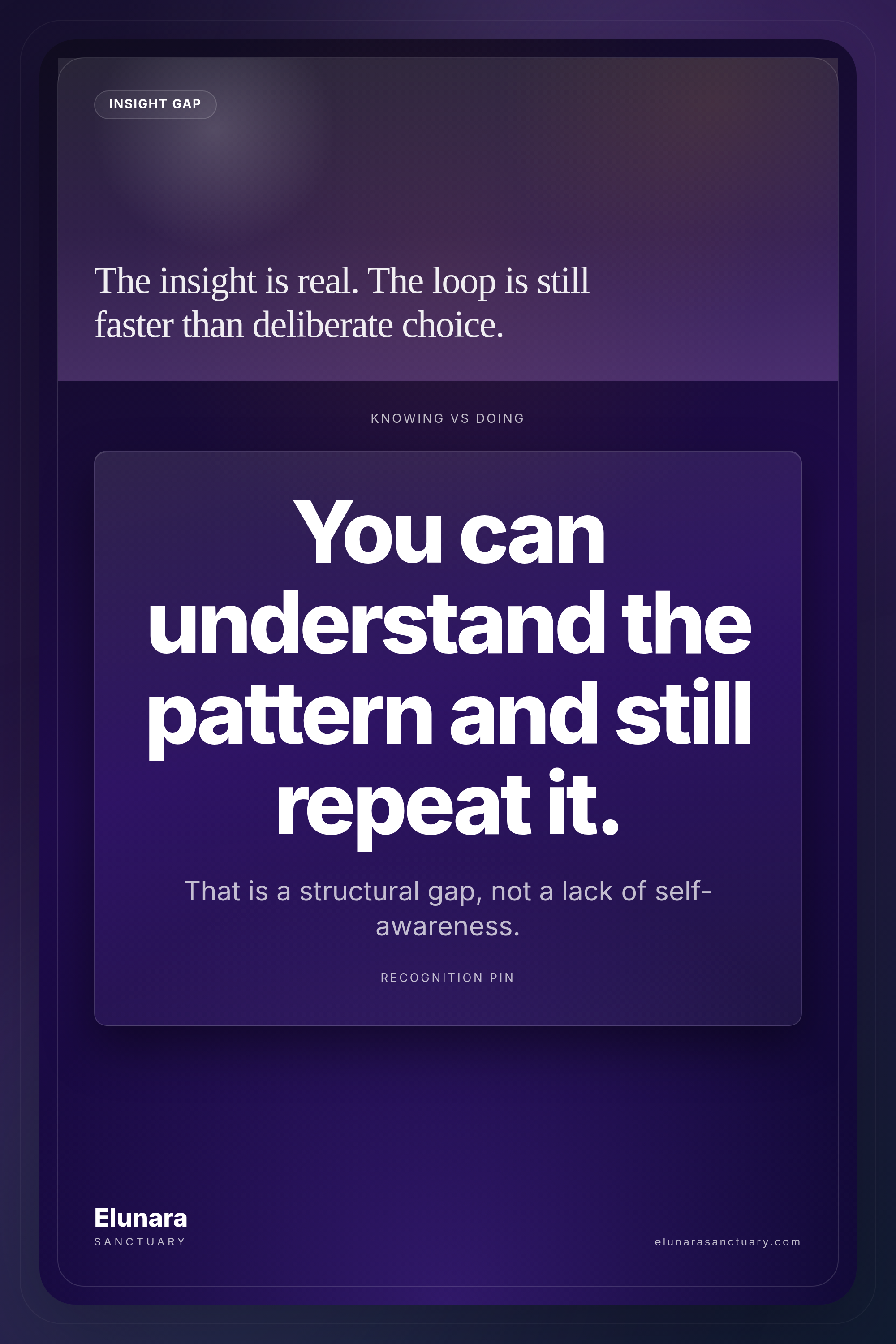
You have the insight. You probably have had it for years. You can describe the pattern accurately, trace its origins, identify when it is running, and name the cost it produces. You have done this work. The pattern is still running.
This is not a failure of intelligence or self-awareness. It is a feature of how insight and behavioral change actually relate to each other — which is not the relationship most self-development frameworks imply.
01What Insight Actually Does
Insight is genuinely valuable. It reduces confusion, builds self-compassion, and ends the search for an explanation. When you understand why you do something, the shame around doing it typically decreases. You stop calling yourself broken.
What insight does not do is interrupt the behavioral sequence that produces the pattern.
The loop does not require your ignorance to operate. It runs at a level below conscious decision-making — in the automatic responses that fire before deliberate choice can engage. You can have perfect understanding of why the loop exists, when it was installed, what purpose it once served — and still find yourself at step seven of the sequence with no memory of deciding to go there.
This is not a paradox. It is a structural distinction. Insight changes the map. It does not automatically change the territory.
02The Gap Between Knowing And Doing
The gap between knowing your pattern and changing your pattern is the most common, most frustrating, and least discussed problem in self-development.
It is the person who has been to therapy for years, has genuine insight into their family dynamics and attachment patterns, and keeps reproducing the same relationship structure. It is the person who knows exactly why they self-sabotage in their career and does it again at the next threshold. It is the person who has read every book on their particular flavor of stuck and is still stuck — not because the books were wrong, but because insight was the output of those books and insight was not the lever.
The lever is protocol. Specifically: a protocol calibrated to the exact step in the exact sequence where the loop exits, for the exact archetype-matrix combination running that exit.
03What A Protocol Does That Insight Cannot
A protocol is not a set of motivational reminders. It is a specific behavioral prescription for a specific moment in a specific sequence.
The distinction matters because most self-improvement tools give you general guidance: be more mindful, use positive self-talk, track your habits, find accountability. General guidance cannot address a specific step in a specific sequence. It can address overall mood or motivation, which helps at steps one and two. It cannot address step four — the specific thought that arrives at the friction point and makes the exit feel like good judgment.
A protocol for step four requires knowing: what the thought sounds like for your archetype, what triggers it in your specific challenge domain, and what behavioral instruction replaces the loop's characteristic response at that exact moment.
This is what the 90-day protocol is built from: the archetype-matrix collision in your specific challenge domain, translated into a daily sequence of tasks, each one calibrated to the behavioral science of pattern interruption at the specific point where your loop is most interruptible.
04The 90-Day Structure
The protocol is divided into three phases:
Phase 1 (Days 1–28): Pattern Interrupt. The goal is awareness without pressure — observing the sequence as it runs, identifying the specific step-four thought, and beginning to name it in real time before acting on it. No high-effort behavior change required. Maximum difficulty is deliberately low.
Phase 2 (Days 29–56): Replacement. Once the sequence is visible, this phase installs alternative responses at the specific exit point. The new response is not generic — it is calibrated to your archetype's characteristic needs at step four. The escape hatch is acknowledged and redirected rather than suppressed.
Phase 3 (Days 57–90): Embody. The new response becomes the default. Identity language shifts. The loop is not erased — it is recognized immediately and responds to a different program at step four.
The daily tasks are adaptive: each evening journal is read by the system, your psychological state is classified, and the next day's content is calibrated to where you actually are rather than where the protocol assumes you should be.
05Your next step
The Blueprint is generated from three inputs specific to you: your behavioral quiz answers (archetype identification), your birth date (eight Matrix of Destiny positions), and the collision point in your chosen challenge domain.
What you receive:
- A 35,000-43,000 word personalized report: your archetype profile, your Matrix blueprint, your 90-day vision narrative, your 13-week protocol roadmap, and your long-term maintenance toolkit
- Permanent access to the 90-day adaptive dashboard — daily morning and evening tasks, a journal system that reads your entries and adjusts the next day's protocol to your actual state, and eleven interactive behavioral tools
- Email support: morning task reminders, evening reflection prompts, streak alerts, and weekly summaries
One-time. No subscription. Permanent access.
One-time · No subscription · Instant generation (3-7 min) · Permanent access
Prefer the free diagnosis first? Start the free analysis → — takes 3 minutes, no card required.