
Why You Keep Choosing The Same Person In Different Bodies
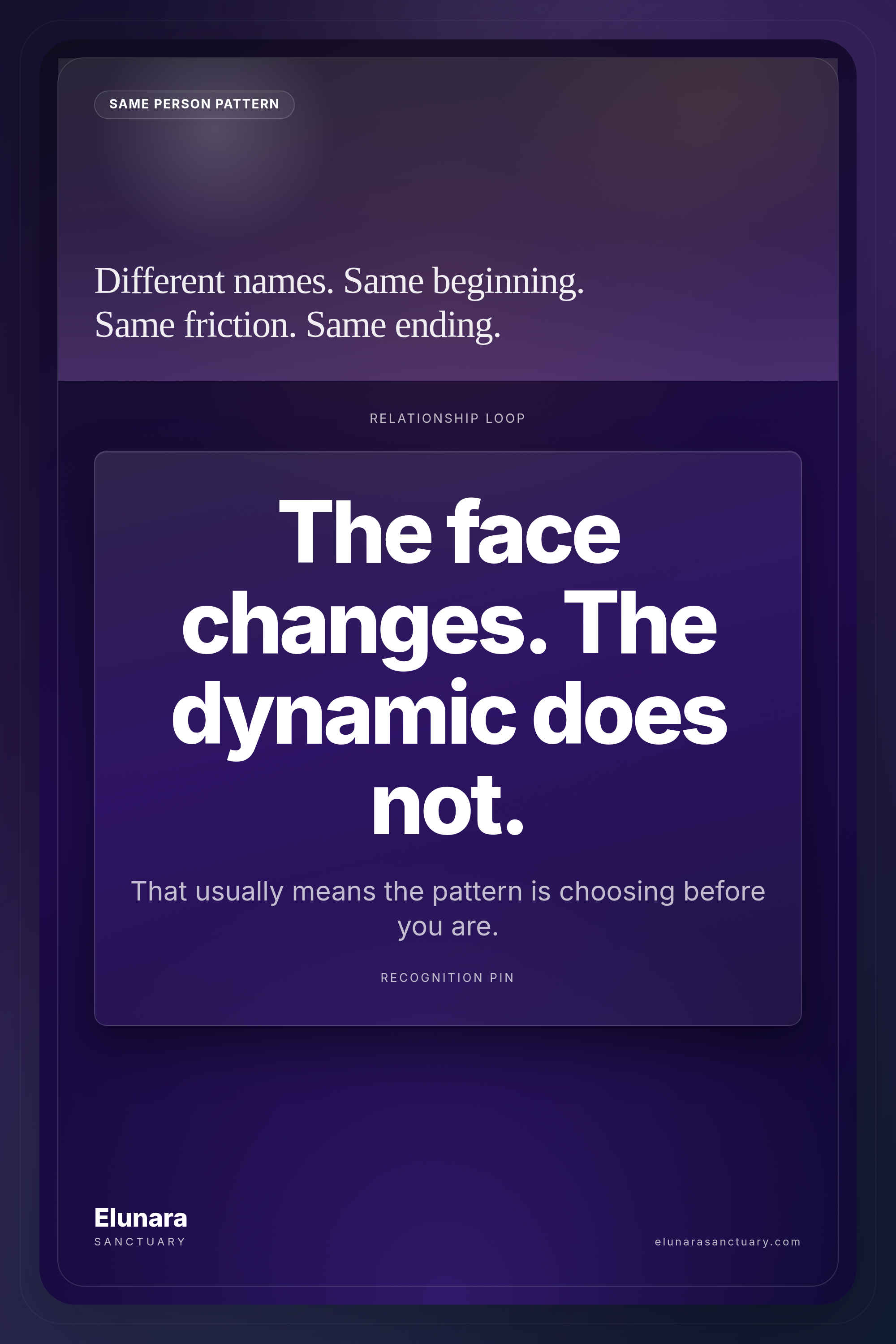
The face changes. The name changes. Sometimes the gender changes. The dynamic does not change.
At some point you noticed it. The way the relationship unfolds — the early intensity, the specific thing that attracts you, the specific thing that eventually becomes the problem — follows a pattern that crosses the individuals involved. The people are different. The pattern is the same.
This is not a type preference in any simple sense. It is a structural loop that selects for certain conditions, produces certain dynamics, and ends at a predictable point — not because of the people you choose, but because of the sequence you are running.
01Where The Pattern Lives
The relationship loop does not live in your partner choices. It lives in the sequence of events that produces those choices, and the sequence that unfolds after the choice is made.
The attraction phase has a specific texture — a quality that the loop finds familiar, which often reads as "chemistry" but is more accurately a recognition of a pattern the loop already knows. The middle phase has a specific friction point — not the ordinary friction of two people learning each other, but a structural moment where the loop encounters the same obstacle it always encounters. The end has a specific shape.
Recognizing this is not a judgment. The loop formed for real reasons. It is running a program that once had a purpose. That program can be named.
02The Archetype Layer In Relationships
The behavioral strategy you developed in early life — one of twelve Jungian archetype patterns — has a characteristic way of relating. Each archetype pattern has a specific version of intimacy it can sustain easily, a specific version that triggers its defenses, and a specific version of the other person it keeps selecting because that person reliably produces the dynamic the pattern knows.
Some patterns select people who confirm their core fear. Others select people who initially contradict it, then gradually approximate it. Others select people who produce a specific kind of tension the archetype uses as evidence for a story it is running about itself or about relationships.
Which archetype you are running is identified by the free analysis — not assumed here. What is universal is the mechanism: partner selection is not random, and it is not simply about "your type." It is about which dynamic your archetype is drawn toward because that dynamic is structurally familiar.
03The Matrix Relationship Layer
The Matrix of Destiny is an eight-position mathematical system derived from your exact birth date — no star charts, no planetary positions, just the numbers encoded in the day you arrived. If you are familiar with Human Design or Gene Keys, it operates at a similar level of specificity — a structural map of the energies you came in with.
One of the eight Matrix positions specifically governs partnership: your approach to intimacy, the mirroring dynamic you are drawn toward, the point of collision in close relationships. When this position conflicts with your archetype's relationship pattern, the loop becomes predictable. What you are drawn to and what you can sustain in close relationship are not aligned — and the gap between them is where the repeating pattern lives.
04The Eight Steps In A Relationship Loop
- The recognition. You meet someone and something registers as significant. The recognition is real — not manufactured. Something about this person activates the pattern's interest.
- The opening phase. The relationship begins with a quality the loop associates with possibility. The connection feels different. The pattern's familiar obstacles have not appeared yet.
- The investment. You become genuinely invested. The relationship deepens. Something real is building.
- The specific friction. A moment arrives where the relationship encounters the loop's characteristic obstacle. This is not a random conflict — it is the same obstacle that appeared in previous relationships, wearing slightly different clothes. Your archetype's shadow meets the other person at a predictable point.
- The step-four thought. This is the same problem I always encounter — it must be them. Or: If I just handle this differently, the dynamic will change. Or: This is not really a problem — I am being too sensitive. Each version maintains the loop.
- The attempt. You work harder, accommodate more, or disengage — depending on your archetype's characteristic response. None of these responses address the loop.
- The resolution or ending. The relationship either finds an equilibrium that maintains the loop's familiar tension, or ends at the loop's characteristic breaking point.
- The attribution. The conclusion drawn from the relationship is about the other person, or about your bad luck, or about relationships in general. The structural loop remains unexamined.
05Why Insight About Your Patterns Did Not Change The Selection
Many people in this loop have spent significant time in self-development or therapy and have a clear intellectual understanding of their relationship patterns. They can describe what they do and why it does not serve them. And then they do it again.
This is not a failure of insight. Understanding the pattern and having a structural protocol for interrupting it at a specific step are different things. The free analysis does not replace therapeutic work. It adds a structural layer: which step in the sequence is the primary exit point, and what specifically triggers the archetype-matrix collision that keeps the loop running.
06Your next step
The free analysis takes approximately three minutes. Your report will show you:
- Your archetype — which of twelve behavioral patterns is running your loop, with your match percentage and the specific shadow behavior it produces in your chosen challenge area
- The Fusion — the equation showing exactly why your specific archetype and Matrix combination creates your specific challenge pattern, built from your quiz answers, not a template
- Your 8-step loop — written from your answers, including the step-four thought your pattern uses and your specific escape hatch at step six
- Five diagnosis points — your exact quiz answers reflected back with their hidden psychological meaning, in the format: "You selected [this]. Here is what that actually reveals."
The free report is the diagnosis. The 90-day protocol (one-time purchase) is the exit: daily tasks adaptive to your archetype and Matrix combination, calibrated each day to your actual state based on your journal entries.
No card required · ~3 minutes · Instant delivery · Private
✦ Frequently Asked Questions
Does this mean I am responsible for my past relationships ending?+
No. This is not about blame - it is about structural pattern recognition. The loop formed for real reasons. Understanding it does not retroactively assign fault.
I am in therapy for this - will this help?+
Many people find the structural framing complements therapeutic work. Elunara is not a replacement for therapy.
Is this about attachment styles?+
It is compatible with attachment frameworks but is not the same thing. The archetype-matrix analysis maps the behavioral sequence the pattern runs, not the attachment category.
Does this work for people who are not currently dating?+
Yes. The relationship pattern runs in existing partnerships and long-term dynamics as well as in new selection.
Knowing About the Shadow Is Not the Same as Naming Yours
Sixteen questions identify the archetype you lead with and the shadow attached to it, then read both against your Matrix position to find where it costs you.
16 questions · about 3 minutes · free